Top 7 10-Gigabit Network Interface Cards in the USA for 2026
Published on Wednesday, February 25, 2026
10-Gigabit Network Interface Cards (NICs) are essential components for enhanced network performance, particularly in high-demand environments such as data centers and enterprise networks. These cards enable rapid, low-latency data communication and deliver the bandwidth modern applications require, including cloud computing, 4K and emerging 8K video workflows, virtualization, and large-scale data transfers. In the U.S. technology market, buyers prioritize a mix of raw throughput, reliability, energy efficiency, driver and OS compatibility, and cost-effective deployment options (SFP+, 10GBase-T, and PCIe form factors). As organizations push for faster storage access, real-time analytics, and denser server consolidation, 10GbE NICs have become a practical upgrade path that balances performance and price across home prosumers, small businesses, and large enterprises.
Top Picks Summary
Intel X710-DA2 Dual Port 10GbE SFP+ Network Adapter
The Intel Ethernet Network Adapter X710-DA2 is a dual‑port SFP+ 10GbE NIC known for broad OS and hypervisor driver support, consistent performance, and strong packet processing offloads that lower CPU utilization. It earns a best‑in‑class spot for enterprise deployments where compatibility, proven driver ecosystems, and predictable total cost of ownership matter compared with niche high‑performance cards like Mellanox or Chelsio. For 10‑Gigabit use cases it balances price, manageability, and virtualization features better than consumer‑oriented options such as the ASUS or TP‑Link cards.

Mellanox ConnectX-4 Lx EN MCX4121A-ACAT
The Mellanox ConnectX‑4 Lx EN (MCX4121A‑ACAT) is a market‑leader for ultra low‑latency, RDMA (RoCE/iWARP) and kernel bypass use cases, delivering superior throughput and CPU offload for HPC and storage fabrics. It stands out against Intel and Broadcom by targeting latency‑sensitive and scale‑out storage environments, albeit at a premium price that is justified when RDMA and advanced offloads materially improve application performance. For 10‑Gigabit NIC selections it is the go‑to when maximal remote direct memory access and minimal latency are primary requirements.

ASUS XG-C100C
The ASUS XG‑C100C is a single‑port 10GBase‑T PCIe card aimed at prosumers and workstation users who need affordable copper 10GbE connectivity without SFP+ optics. It is best‑in‑class among consumer options for ease of use, price per port, and broad desktop motherboard compatibility, though it trades higher power draw and slightly higher latency for cost savings compared with SFP+ enterprise adapters like Intel or Mellanox. For users upgrading home labs or creative workstations it provides the most accessible path to 10‑Gigabit networking versus server‑grade alternatives.

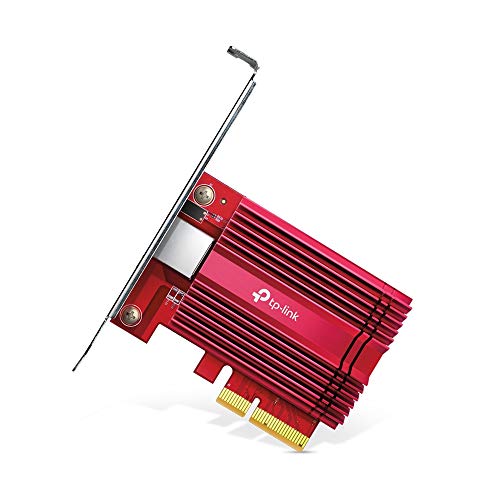
TP-Link TX401 10 Gigabit PCIe Network Card
The TP‑Link TX401 is a value‑oriented 4‑port 10GBase‑T NIC that delivers high port density at a lower entry price, making it attractive for small businesses and multi‑port desktop aggregations. Its financial advantage is clear versus single‑port consumer NICs and many enterprise cards, offering more 10Gb ports per dollar, though it lacks the advanced RDMA and enterprise offloads of Mellanox or Chelsio. For 10‑Gigabit deployments prioritizing port count and budget over ultra‑low latency, the TX401 is a pragmatic market‑leading choice.
Broadcom BCM957414A4142CC
The Broadcom BCM957414A4142CC represents Broadcom's server‑grade 10GbE silicon and reference adapter designs that are widely deployed by OEMs for datacenter servers and storage arrays. It is a market leader in terms of ecosystem penetration and hardware offload breadth, offering strong hardware acceleration and enterprise manageability that competes directly with Intel in standardized environments. While Broadcom solutions are often costlier than consumer cards, their reliability, firmware maturity, and OEM support make them preferable for large scale 10‑Gigabit rollouts.

Chelsio T520-CR
The Chelsio T520‑CR is a dual‑port 10GbE adapter focused on advanced TCP offloads, iSCSI and storage acceleration that reduce host CPU load in heavy I/O environments. It holds a best‑in‑class position for storage‑centric deployments where Chelsio's TOE and storage protocol offloads can yield better throughput per CPU dollar than more general purpose Intel or Broadcom cards. For 10‑Gigabit networks serving storage clusters or virtualized storage appliances, Chelsio offers a strong technical and financial case through reduced server CPU requirements and predictable storage latency.

Synology E10G21-F2
The Synology E10G21-F2 is a high-performance network interface card supporting 10GbE connectivity, making it ideal for data-intensive applications. It features dual ports for enhanced bandwidth and redundancy, allowing seamless data transfer. Its user-friendly installation and compatibility with Synology's NAS devices set it apart from competitors. The card is designed for professionals looking to optimize network performance while ensuring reliability.
350-450$
Research and Evidence Supporting 10-Gigabit NIC Benefits
Academic and industry research, along with standardized benchmarking, underline the practical advantages of 10-Gigabit NICs. Studies and reports from networking conferences, standards bodies, and performance benchmarks consistently show that 10GbE deployments reduce application latency, increase effective throughput, and improve CPU efficiency when coupled with modern offload features. For administrators evaluating upgrades, the documented gains in virtualization density, storage throughput for iSCSI/NFS, and lower per-Gigabit cost in dense environments make a strong case for adopting 10GbE.
Throughput and latency: Benchmarks using tools like iperf and netperf demonstrate substantially higher sustained throughput and lower latency compared with 1GbE, benefiting real-time services and large file transfers.
CPU offload and protocol acceleration: Features such as TCP segmentation offload (TSO), large receive offload (LRO), and RDMA reduce CPU utilization, which research shows improves application performance in virtualized and storage-heavy workloads.
Standards and interoperability: IEEE 802.3an (10GBase-T) and SFF standards for SFP+ ensure interoperability among vendors, simplifying deployment in heterogeneous environments.
Storage and virtualization: Studies indicate that moving to 10GbE can increase IOPS and reduce storage access times for iSCSI and NFS workloads, enabling higher VM density per host.
Energy and cost efficiency at scale: While per-port cost is higher than 1GbE, total cost of ownership in data center and edge aggregation scenarios often favors 10GbE due to reduced switch ports and higher effective throughput.
Frequently Asked Questions
Which 10GbE NIC should I buy for enterprise hypervisors?
For enterprise hypervisors, choose the Intel Ethernet Network Adapter X710-DA2: it’s a dual-port SFP+ 10GbE NIC with virtualization offloads like SR-IOV and VMDq, rated 4.6, and priced at $140.67.
Does the Mellanox ConnectX-4 Lx MCX4121A support RDMA?
Yes—the Mellanox ConnectX-4 Lx EN MCX4121A-ACAT provides RDMA support with RoCE and iWARP for low-latency workloads, using SFP+ connectivity, rated 4.7, and listed for $79.00 USD
Is the ASUS XG-C100C cheaper than SFP+ server NICs?
Yes: the ASUS XG-C100C single-port 10GBase-T PCIe card is $97.99 USDversus the Mellanox ConnectX-4 Lx MCX4121A-ACAT at $97.99 USDand the Intel X710-DA2 at $97.99 USD
Will ASUS XG-C100C work for a desktop with PCIe?
The ASUS XG-C100C uses a PCIe 3.0 x4 interface and offers a single 10GBASE-T RJ45 port for direct copper connections, rated 4.3 and priced at $97.99 USD
Conclusion
In the U.S. market for 2026, 10-Gigabit NICs remain a practical upgrade for organizations and advanced home users seeking greater throughput, lower latency, and better resource efficiency. The top picks on this page include the Intel Ethernet Network Adapter X710-DA2, Mellanox ConnectX-4 Lx EN MCX4121A-ACAT, ASUS XG-C100C, TP-Link TX401, Broadcom BCM957414A4142CC, Chelsio T520-CR, and Synology E10G21-F2. For most enterprise and prosumer buyers looking for the best balance of compatibility, performance, and driver support, the Intel Ethernet Network Adapter X710-DA2 is the best choice among these options. We hope you found the information you were looking for; you can refine or expand your search using the site search to compare interfaces, form factors, and price ranges.