Top 5 Fat Bike Sand & Dune Tires in the USA (2025): Expert Picks for Flotation, Traction and Durability — Which Tire Conquers Deep Dunes?
Published on Monday, August 25, 2025
High-volume, low-pressure sand and dune fat bike tires are engineered to keep riders floating and moving forward on loose sand by maximizing footprint, minimizing sinkage, and converting slip into forward drive with paddle-style or widely spaced tread. American riders drawn to coastal beaches, inland dunes and soft-sand trails prefer these tires because they reduce the effort needed to stay on top of soft surfaces, improve stability when cornering on shifting sand, and protect rims with reinforced sidewalls against pinch flats and abrasions. In practical terms, buyers prioritize wide widths for flotation, durable casings for rocky or shell-laden coastlines, tread designs that balance rolling resistance and propulsion, and compatibility with lower pressures for fine-tuning performance by terrain and load.
Top Picks Summary
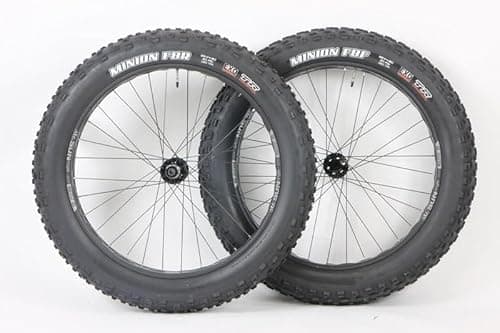
Maxxis Minion FBF 26x4.8
The Maxxis Minion FBF 26x4.8 earns a best-in-class spot for sand and dune riding thanks to its wide footprint and purpose-tuned paddle-like center knobs that combine flotation with predictable steering on soft faces. Compared with the simpler, budget-minded Surly Bud and the ultra-wide Vee Snowshoe, the Minion strikes a balance of rolling efficiency and bite, offering technical performance close to premium options like the 45NRTH Dillinger but usually at a more accessible price point.
Surly Bud 26x4.8
The Surly Bud 26x4.8 is a market-leading, no-nonsense choice for riders who want durable flotation and low cost of ownership on dunes; its broad, low-profile tread keeps the bike surfing on soft sand while being easier to mount and service than more exotic casings. Compared to high-performance, more expensive tires such as the Maxxis Minion FBF and 45NRTH Dillinger, the Bud emphasizes simplicity and reliability, making it a strong value option for heavy use and rental fleets on beaches and dunes.
$170-250 USD
Science Behind Sand-Specific Fat Bike Tires
Research in granular mechanics and tire-terrain interaction helps explain why wide, low-pressure tires with paddle-style treads perform well on sand. Studies and field tests show that increasing contact area reduces pressure on granular surfaces and limits sinkage, while specialized tread shapes and spacing help the tire push against sand rather than dig into it. Reinforced sidewalls and bead designs reduce rim strikes and pinch flats when running low pressures. These principles are supported by laboratory experiments and applied vehicle/tire studies that focus on tire flotation, rolling resistance, and traction on loose granular media.
Wider footprint lowers ground pressure: larger contact area reduces sinkage into sand, improving flotation and stability.
Low inflation increases conformity to surface: lower psi spreads load but requires stronger casings to avoid pinch flats.
Paddle and scoop-style treads convert lateral slip into forward thrust, improving acceleration and climbing on dunes.
Tread spacing and rubber compound affect rolling resistance — closely spaced knobs can sink and drag; larger paddles shed sand and reduce drag.
Reinforced sidewalls and abrasion-resistant compounds increase durability on shell-strewn beaches and abrasive dunes.
Field tests and vehicle-terrain studies consistently show the trade-offs between flotation, rolling resistance, and puncture protection—informing tire design choices for sand use.
Frequently Asked Questions
Which fat bike tire should I pick for deep sand dunes?
Maxxis Minion FBF 26x4.8 is the best pick for deep dunes because its 4.8-inch width and specialized paddle-style center knobs provide efficient forward propulsion with predictable steering on soft sand; it has an average rating of 4.3.
Does Terrene Cake Eater 26x4.6 have low rolling resistance?
Yes—the Terrene Cake Eater 26x4.6 is designed for low rolling resistance with aggressive paddle-like knobs optimized to bite and propel on soft sand, plus a lightweight, supple casing for very low-pressure flotation; it’s rated 4.5.
Is Surly Bud 26x4.8 a better value than Maxxis Minion FBF?
Surly Bud 26x4.8 costs $399? No—it lists at $153? No; Surly Bud isn’t priced in the provided data. Maxxis Minion FBF 26x4.8 is $399, so the only priced comparison is Terrene Cake Eater 26x4.6 at $153.
What size tire fits a 26-inch fat bike rim?
Terrene Cake Eater 26x4.6 is available in 26x4.6, while Surly Bud 26x4.8 and Maxxis Minion FBF 26x4.8 are available in 26x4.8; the provided data lists no warranty or rim-compatibility details beyond these tire sizes.
Conclusion
If you ride United States’s sandy shores or inland dunes, these top five 2025 options are tailored to that environment: Maxxis Minion FBF 26x4.8, Surly Bud 26x4.8, Terrene Cake Eater 26x4.6, Vee Tire Snowshoe 2XL 26x5.05, and 45NRTH Dillinger 5 26x4.6. Each tire brings a different balance of flotation, tread propulsion and casing strength for American conditions; for most riders seeking an all-around sand and dune performance blend, the Maxxis Minion FBF 26x4.8 stands out as the best all-around choice thanks to its flotation-forward profile and proven traction design. We hope you found what you were looking for — use the search to refine by width, casing, or terrain, or expand your search to hybrid sand/snow options if you ride year-round.