Top 5 Window Films (2025–2026): Elevate Comfort and Style in the USA
Published on Wednesday, February 25, 2026
Window films are thin, adhesive sheets applied to glass to reduce glare, enhance privacy, and improve energy efficiency. In the USA, consumers increasingly choose window films as an affordable, noninvasive retrofit for homes, apartments, and vehicles. Driven by rising energy costs, greater awareness of UV damage, and a stronger focus on sustainable living, Americans value films that deliver measured heat rejection, high UV protection, and long-term clarity without compromising curb appeal. The market favors ceramic and low-E technologies for their superior solar control and minimal signal interference, while budget-friendly dyed or metallized films remain popular for interior privacy and simple glare control. Whether the priority is cutting cooling bills in hot climates, reducing fading of fabrics and flooring, improving occupant comfort in mixed climates, or upgrading the look of a room, window films offer a versatile, easy-to-install solution that appeals to homeowners, renters, and businesses across the country.
Top Picks Summary
3M Prestige Series Window Film
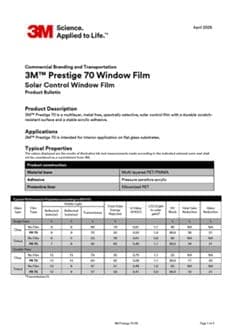
3M Prestige Series holds a best-in-class position for 2025 because its multi-layer, nonmetallic technology delivers industry-leading visible light transmission and IR heat rejection without the reflective or metallic look of many competitors. Compared with LLumar's ceramic IRX, Prestige generally offers comparable thermal performance with slightly higher optical clarity and a larger professional installer network, though it typically carries a premium price relative to Gila's DIY value and Solar Gard's Low‑E insulation-focused offering.
$89-299
Research and standards behind window film benefits
Scientific testing and building industry guidance support the main benefits of window films: reduced solar heat gain, strong ultraviolet blocking, and improved occupant comfort. Government and industry organizations provide data and test protocols used by manufacturers and independent labs to measure performance. For consumers, understanding the basic metrics—solar heat gain coefficient (SHGC), visible light transmission (VLT), and ultraviolet (UV) rejection—helps compare options and choose films that match climate and aesthetic goals.
Energy and cooling savings: U.S. Department of Energy and energy-efficiency research show that reducing solar heat gain through glazing upgrades or window films can lower cooling demand; advanced films typically reduce solar heat gain enough to cut summer HVAC load and improve peak-load performance.
UV protection and material preservation: Laboratory measurements and manufacturer test results demonstrate that many window films block up to 99% of UVA and UVB rays, slowing fading of fabrics, artwork, and finishes and reducing interior sun damage.
Glare and visual comfort: Peer-reviewed studies and ergonomic guidance show that lowering direct glare and controlling visible light transmission improves task comfort and reduces eye strain in home offices and living spaces.
Standards and testing: Performance claims are commonly validated against industry standards and protocols such as ASTM test methods and window performance metrics tracked by organizations like NFRC, helping consumers compare SHGC, VLT, and visible light reflectance.
Material and signal considerations: Modern ceramic films use nonmetallic nano-ceramic particles to reject infrared heat while avoiding the radio-frequency interference associated with older metalized films; independent lab tests confirm improved heat rejection with minimal effect on wireless signals.
Frequently Asked Questions
What is the best top 5 window films (2025–2026) in USA in 2026?
As of April 2026, 3M Prestige Series Window Film is the top choice for top 5 window films (2025–2026) in USA. 3M Prestige Series holds a best-in-class position for 2025 because its multi-layer, nonmetallic technology delivers industry-leading visible light transmission and IR heat rejection without the reflective or metallic look of many competitors. Compared with LLumar's ceramic IRX, Prestige generally offers comparable thermal performance with slightly higher optical clarity and a larger professional installer network, though it typically carries a premium price relative to Gila's DIY value and Solar Gard's Low‑E insulation-focused offering.
What are the key features of 3M Prestige Series Window Film?
3M Prestige Series Window Film features: Advanced nanotechnology ceramic construction delivers high heat and UV rejection without metallic tint, Blocks up to 99% of UV rays to protect interiors and reduce fading, Virtually clear appearance preserves outdoor views and won’t interfere with electronic signals.
What are the benefits of 3M Prestige Series Window Film?
The main benefits include: Crystal clear view, High heat defense, Metal-free shimmer.
How does 3M Prestige Series Window Film compare to XPEL Prime XR Plus Ceramic Window Film?
Based on April 2026 data, 3M Prestige Series Window Film is rated 4.8/5 while XPEL Prime XR Plus Ceramic Window Film is rated 4.8/5. Both are excellent choices, but 3M Prestige Series Window Film stands out for Advanced nanotechnology ceramic construction delivers high heat and UV rejection without metallic tint.
Conclusion
This roundup highlights five standout choices for Americans looking to upgrade windows in 2025 and into 2026: 3M Prestige Series Window Film, XPEL Prime XR Plus Ceramic Window Film, LLumar Ceramic Series IRX Window Film, Gila Heat Control Platinum Window Film, and Solar Gard Ecolux Low-E Window Film. Each product offers a mix of heat rejection, UV protection, and aesthetic options; among them, the 3M Prestige Series Window Film stands out as the best overall pick for balanced performance, clarity, and trusted lab-tested results. We hope you found the information you needed — use the site search to refine by price, performance (SHGC, VLT), or installation type if you want to narrow or expand your options.