FPV Racing Drones 2026: Top 5 Picks in the USA
Published on Monday, January 26, 2026
FPV Racing Drones offer an exhilarating experience for drone enthusiasts, enabling pilots to race through complex courses at high speeds with first-person view goggles. In the USA the category has matured into a mix of ready-to-fly models, bind-and-fly racers, and custom builds that balance speed, durability, and low-latency video. American buyers tend to favor strong digital video systems for clear HD feed, but many racers still choose analog setups for the lowest latency and the lightest builds. Consumers look for robust frames, easy spare-part availability, intuitive flight controllers like Betaflight or INAV, and clear compliance with FAA rules such as registration and Remote ID. Whether you are a beginner seeking a durable trainer or a competitive pilot tuning a race build, 2026 market trends show more accessible simulators, better battery and motor tech, and deeper community racing leagues across the country.
Top Picks Summary
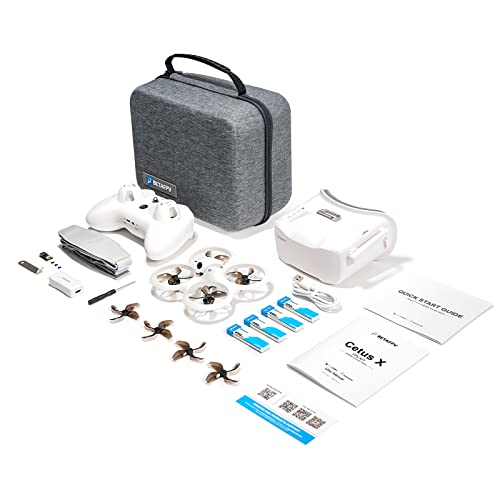
BetaFPV Cetus X
The BetaFPV Cetus X is an entry-focused micro racer that earns its spot for offering a very approachable, modular platform at a budget-friendly price — ideal for pilots moving up from simulators or toy quads. Compared with heavier or more powerful builds on this list, the Cetus X trades top-end speed for easy handling, replaceable components and low running costs, making it a cost-effective training and park-racing choice before stepping up to mid‑size racers like the iFlight Nazgul Evoque F5.
iFlight Nazgul Evoque F5 V2 6S FPV Drone
The iFlight Nazgul Evoque F5 is positioned as a market-leading mid‑size racing platform thanks to its punchy powertrain, durable carbon frame and race-tuned flight characteristics that favor competitive pilots. Technically it outpaces the cine-oriented GEPRC CineLog35 V2 and tiny indoor quads here in raw acceleration and agility, while still offering a better value-for-performance ratio than top-tier cine/FPV hybrids like the DJI Avata 2 for pilots prioritizing lap times over HD onboard cinema.

GEPRC CineLog35 V2
The GEPRC CineLog35 V2 is a hybrid cine-racer that stands out for delivering smooth, camera-forward flight and prop-guarded frames that protect gear during aggressive but filmed runs; it’s a best-in-class choice when cinematic capture and agile handling need to coexist. Compared with pure racing builds such as the iFlight Nazgul Evoque F5, the CineLog35 V2 sacrifices a bit of top speed for stabilized footage and quieter motors, and it typically commands a mid-range price that undercuts premium digital cine systems while offering superior image stability to budget micros like the Tinyhawk III Plus.

Emax Tinyhawk III Plus
The Emax Tinyhawk III Plus is a compact, durable micro racer that excels as an affordable, ready-to-fly training and indoor racing platform for beginners and club pilots. It’s one of the most budget-conscious options on this list, offering low-cost spares and gentle performance compared with the higher-power Nazgul Evoque F5 and cine-focused CineLog35 V2, making it a smart low-risk way to build pilot skills before investing in heavier, faster rigs or the higher-cost DJI Avata 2.

DJI Avata 2
The DJI Avata 2 is the market leader for immersive, high-quality digital FPV flight, combining advanced obstacle-aware safety features and a crystal-clear HD video link that makes it the go-to for cinematic racing-style flights and content creators. While considerably more expensive and less open to hardware-level tuning than traditional analog racing quads like the iFlight Nazgul Evoque F5, the Avata 2’s superior image capture and plug‑and‑play reliability give it a technical and usability edge for pilots prioritizing footage quality and stable flights over raw race performance.

Research and Benefits of FPV Racing
Research in human factors, robotics, and informal STEM education supports many benefits of FPV flying. Studies indicate that immersive remote piloting and repeated practice improve hand-eye coordination, reaction time, and spatial awareness. Educational programs that use drones report better engagement in engineering and programming concepts, and simulator-based training reduces crash risk while accelerating skill development. Safety research also emphasizes protective gear, prop guards for indoor practice, and conservative battery handling to reduce incidents.
Improves hand-eye coordination and fine motor control through repeated, goal-oriented flight tasks.
Enhances spatial reasoning and situational awareness by training pilots to interpret first-person video in real time.
Simulator training shows measurable skill transfer to physical drones, reducing crashes and equipment damage.
STEM studies report increased student engagement and problem solving when drone projects are included in curricula.
Safety research recommends proper battery care, preflight checks, use of failsafes, and awareness of FAA requirements.
Frequently Asked Questions
Should I buy BetaFPV Cetus X for indoor racing practice?
Choose the BetaFPV Cetus X if you want an entry-focused micro racer for safe indoor training, with a ducted micro design, beginner-friendly flight modes, and an RTF-style setup with an integrated FPV camera; it’s rated 4.4 and costs $254.99 USD
What spec makes iFlight Nazgul Evoque F5 good for sprints?
The iFlight Nazgul Evoque F5 uses a sturdy 5-inch platform with high-power motors tuned for aggressive sprint speeds, plus high-current ESCs and a responsive race-focused flight stack; it’s rated 4.6 and listed at $1710.35.
Is GEPRC CineLog35 V2 cheaper than iFlight Nazgul Evoque F5?
Yes—GEPRC CineLog35 V2 is $619.99 USDwhile iFlight Nazgul Evoque F5 is $619.99 USDand the CineLog35 V2 brings a compact 3.5-inch cine-racer frame with camera-forward design and mounts compatible with popular micro HD and analog cameras; it’s rated 4.4.
What warranty is included with GEPRC CineLog35 V2?
GEPRC CineLog35 V2 warranty duration isn’t listed in the provided product details, so I can’t confirm coverage time; the only facts given are a 3.5-inch camera-forward cine-racer design, rating 4.4, and price $619.99 USD
Conclusion
In the USA market these five models represent the range of what pilots want in 2026: BetaFPV Cetus X for entry level training and safer indoor practice, iFlight Nazgul Evoque F5 for competitive racing performance, GEPRC CineLog35 V2 for a versatile cine-racer hybrid, Emax Tinyhawk III Plus as a durable micro option, and DJI Avata 2 for polished digital FPV and cinematic ease of use. For most serious racers the iFlight Nazgul Evoque F5 is the best choice on this list if pure speed and tuning for competition are your priority. We hope you found what you were looking for — refine or expand your search using the search box to filter by price, skill level, or flight system.