Top 7 Professional Audio Interfaces in the USA for 2026
Published on Thursday, February 26, 2026
Professional audio interfaces are essential for musicians, producers, and sound engineers, providing high-quality audio input and output with minimal latency. In the United States, home to a vibrant music scene and a large audio production industry, demand for reliable, low-noise, and flexible interfaces has surged. These devices serve as the bridge between microphones, instruments, and computers, supporting a wide range of audio software and enabling seamless recording, mixing, and monitoring workflows. Consumer preferences in the US market tend toward interfaces that combine exceptional analog-to-digital and digital-to-analog conversion, robust mic preamps, stable drivers, and modern connectivity like Thunderbolt, USB-C, and network audio standards. Portability, expandability, onboard DSP for near-zero-latency monitoring, and clear product ecosystems with plugin support are also high priorities. As more professionals set up home studios and collaborate remotely, choosing the right interface depends on channel count, I/O flexibility, latency performance, and long-term driver and firmware support.
Top Picks Summary
Universal Audio Apollo x4
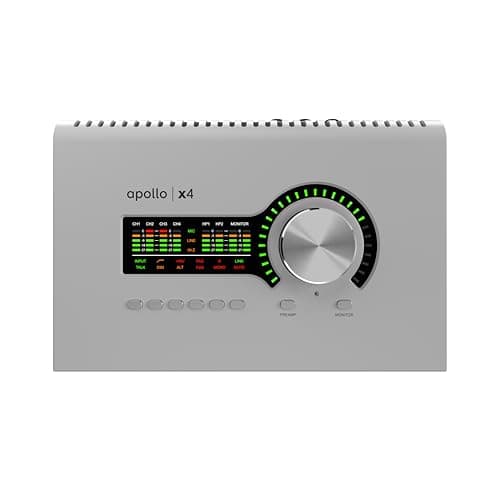
The Universal Audio Apollo x4 is a premium audio interface that sets a high standard in studio quality. With its built-in UAD processing, users can track with industry-leading plug-ins in real-time, providing unmatched audio fidelity and flexibility. The Apollo x4 also features a stunning 4-in/4-out configuration with world-class AD/DA conversion, offering clarity and detail that surpasses competitors. Its elegant design and comprehensive software bundle make it an ideal choice for professional musicians and sound engineers alike.
Why high-quality audio interfaces matter: research-backed benefits
Industry research and peer-reviewed work in audio engineering show that interface performance affects both technical results and human perception. Objective measures such as dynamic range, signal-to-noise ratio, total harmonic distortion plus noise (THD+N), and jitter directly influence recording fidelity. Studies and technical reports from audio engineering organizations demonstrate that stable drivers and low round-trip latency improve real-time performance and creativity during tracking. While some measurable improvements can be subtle to untrained listeners, trained engineers and critical listeners consistently report better results with high-end conversion and preamplification, especially in professional mixing and mastering contexts.
Low latency is critical for real-time monitoring and tracking; round-trip latency under roughly 10 milliseconds is generally imperceptible to performers.
High dynamic range and low noise floor preserve detail and headroom, reducing the need for corrective processing later in the signal chain.
Quality ADC and DAC circuits reduce distortion and timing errors, which is important for mixing, mastering, and multitrack recording.
Stable drivers and solid firmware reduce dropouts and improve session reliability, a key factor validated by user studies across professional studios.
Onboard DSP and real-time monitoring reduce CPU load on host systems and allow zero-latency monitoring with effects, backed by industry adoption and performance evaluations.
Frequently Asked Questions
What is the best top 7 professional audio interfaces for 2026?
As of April 2026, Universal Audio Apollo x4 is the top choice for top 7 professional audio interfaces for 2026 in USA. The Universal Audio Apollo x4 is a premium audio interface that sets a high standard in studio quality. With its built-in UAD processing, users can track with industry-leading plug-ins in real-time, providing unmatched audio fidelity and flexibility. The Apollo x4 also features a stunning 4-in/4-out configuration with world-class AD/DA conversion, offering clarity and detail that surpasses competitors. Its elegant design and comprehensive software bundle make it an ideal choice for professional musicians and sound engineers alike.
What are the key features of Universal Audio Apollo x4?
Universal Audio Apollo x4 features: High-quality audio conversion, Real-time UAD plugin processing, Four Unison preamps for versatile recording.
How much does Universal Audio Apollo x4 cost?
Currently in 2026, Universal Audio Apollo x4 is priced at $2299.00.
What are the benefits of Universal Audio Apollo x4?
The main benefits include: World-class audio quality 🎵, Low latency performance 🚀, Versatile I/O options 🔌.
How does Universal Audio Apollo x4 compare to RME Fireface UCX II?
Based on April 2026 data, Universal Audio Apollo x4 is rated 4.8/5 while RME Fireface UCX II is rated 4.8/5. Both are excellent choices, but Universal Audio Apollo x4 stands out for High-quality audio conversion.
Conclusion
In the US market, the right audio interface balances sound quality, connectivity, and workflow needs. The seven main options covered here — Universal Audio Apollo x4, RME Fireface UCX II, Apogee Symphony I/O Mk II, Focusrite Scarlett 4i4 4th Gen, MOTU 828es, Audient iD14 MKII, and SSL 2+ — represent a range from high-end studio converters and DSP-enabled workstation interfaces to compact, budget-friendly units for project studios. For most professional users who need a combination of pristine conversion, reliable drivers, and integrated realtime processing, the Universal Audio Apollo x4 stands out as the best overall choice on this list. RME Fireface UCX II and Apogee Symphony I/O Mk II are excellent for engineers focused on rock-solid stability and top-tier conversion respectively; Focusrite Scarlett 4i4 4th Gen and Audient iD14 MKII offer strong value for small studios; MOTU 828es is notable for routing and network audio features; and SSL 2+ brings classic console-style feel in an affordable package. I hope you found what you were looking for — you can refine or expand your search by channel count, connectivity (Thunderbolt, USB-C, AVB), DSP needs, or price using the site search.